Death of Dr. Lanyon
Dr. Hastie Lanyon, a hearty, healthy, dapper, red-faced gentleman with a shock of prematurely white hair and a boisterous, decided manner, was one of the oldest friends of Henry Jekyll and a lifelong companion of Mr. Utterson. A thorough respecter of himself and of others, Lanyon had nonetheless broken with Jekyll more than ten years before the main events, estranged by what he called Jekyll's "unscientific balderdash" and "scientific heresies." He had seen little of the man since, and when Utterson first inquired about Hyde, Lanyon had never even heard the name. This robust, skeptical figure, a man who enjoyed life and declared he "used to like it," was to be the first person outside Jekyll himself to witness the full, horrifying truth of the transformations—and the knowledge destroyed him.
The Shock and the Physical Collapse
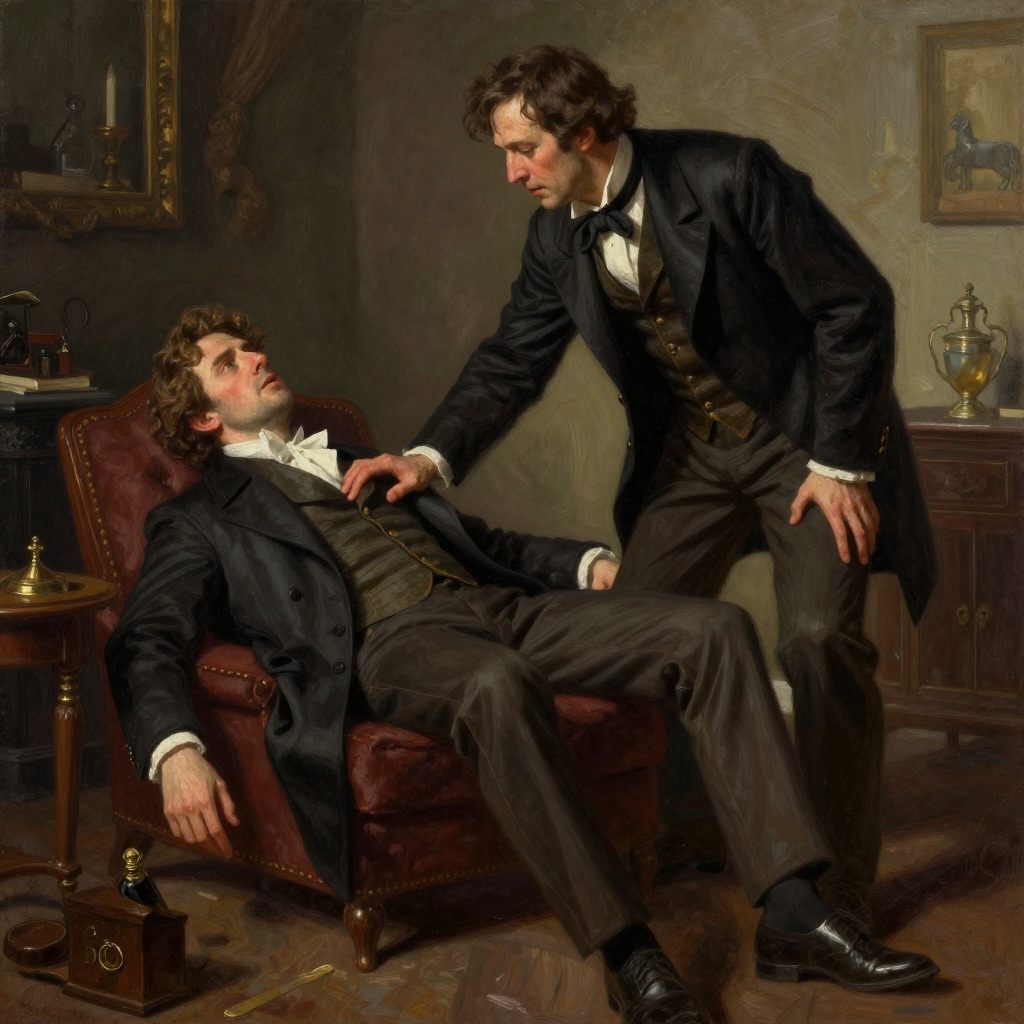
On the night of January 9th, Lanyon, acting on a desperate, registered letter from Jekyll, admitted a small, deformed stranger to his home in Cavendish Square. The visitor, whom Lanyon had never seen before, was Edward Hyde. Under Lanyon's own roof, Hyde compounded a drug from a drawer Lanyon had retrieved from Jekyll's cabinet, drank it, and before Lanyon's eyes transformed into Henry Jekyll. The sight, which Lanyon later described as a "prodigy to stagger the unbelief of Satan," shattered his entire worldview. When Utterson visited him shortly afterward, on the 15th of January, he was shocked at the change. The rosy, vigorous doctor had grown pale; his flesh had fallen away; he was visibly balder and older. But more arresting than these tokens of swift physical decay was a look in his eye and a quality of manner that seemed to testify to some deep-seated terror of the mind. Lanyon declared himself a doomed man with an air of great firmness, stating, "I have had a shock, and I shall never recover. It is a question of weeks."
The Rupture with Jekyll and the Refusal to Speak
Lanyon's encounter with the truth produced an absolute and violent rupture with Jekyll. When Utterson, concerned about Jekyll's own seclusion, asked if Lanyon had seen him, Lanyon's face changed and he held up a trembling hand. "I wish to see or hear no more of Dr. Jekyll," he said in a loud, unsteady voice. "I am quite done with that person; and I beg that you will spare me any allusion to one whom I regard as dead." He refused to explain further, telling Utterson that after his own death, Utterson might "come to learn the right and wrong of this," but that he could not tell him now. He could not bear the topic, and begged Utterson to stay and talk of other things or else to go. This refusal, born of a terror so profound it had stripped him of his former geniality, left Utterson to piece together the mystery from the outside, deepening the sense of an unspeakable horror at the story's core.
The Death and the Sealed Narrative
A week after Utterson's visit, Lanyon took to his bed, and in something less than a fortnight he was dead. The night after the funeral, Utterson, sadly affected, locked himself in his business room and drew out an envelope addressed by Lanyon's hand and sealed with his seal. It was emphatically superscribed: "PRIVATE: for the hands of G. J. Utterson ALONE, and in case of his predecease to be destroyed unread." Within, Utterson found another enclosure, likewise sealed, marked "not to be opened till the death or disappearance of Dr. Henry Jekyll." The reappearance of the word "disappearance," bracketed with Jekyll's name as it had been in the mad will, struck Utterson with a great curiosity, but professional honour and faith to his dead friend kept the packet locked in the inmost corner of his private safe. Lanyon's death thus became the event that forced the narrative into its final, documentary form: his sealed account, combined with Jekyll's own confession, would be the only means by which the full truth could ever be known.
Thematic Significance: The First Casualty of Forbidden Knowledge
Lanyon's death functions as the story's first concrete proof that the secret of Jekyll and Hyde is not merely a moral or psychological crisis but a physically lethal one. He is the character who most embodies the rational, materialist, and sociable world that Jekyll's experiments violate. His destruction is not by violence but by the sheer, unbearable weight of a truth his mind cannot accommodate. He dies incredulous, as he himself wrote: "My life is shaken to its roots; sleep has left me; the deadliest terror sits by me at all hours of the day and night; and I feel that my days are numbered, and that I must die; and yet I shall die incredulous." His death marks the point at which the mystery ceases to be a puzzle for Utterson to solve and becomes a tragedy with a body count, clearing the way for the final revelations that will follow from his and Jekyll's posthumous documents.